
Sunday morning. Your son steps on the scales before breakfast, as he does every week, and the number comes up: +2 kg in a month.
You are not quite sure what to make of it. He wanted to get stronger in the duels, so maybe it is a good thing. But he has also been snacking quite a bit these past few weeks, so maybe it is not.
Those two kilos could be muscle, growth, a little fat, or simply water stored in the muscles because he is finally eating enough carbohydrates. On the scales, all of that shows exactly the same number.
That is why, from the age of 15, I also measure my players' body composition. Here is what that means in practice, what the methods you will come across in academies are worth, and the limits I set myself with teenagers.
1. What the scales lump together
Body weight adds everything up: muscle, fat, bone, water, and even whatever is still in the stomach and intestines. From one morning to the next, it can move by one or two kilos without anything lasting having changed. A very salty dinner, a hard session, a late return from an away trip, and the next day's number tells a different story from reality.
BMI has the same flaw. It relates weight to height without knowing what that weight is made of. A very muscular player can come out as overweight on paper with very little body fat. In a teenager, BMI is never read on its own anyway, but on an age-based growth chart.
Two players at 1.79 m and 70 kg can be eight kilos of fat apart. You feel it in the repeated sprints at the end of a match.
2. Callipers, DEXA, smart scales: what each method is worth
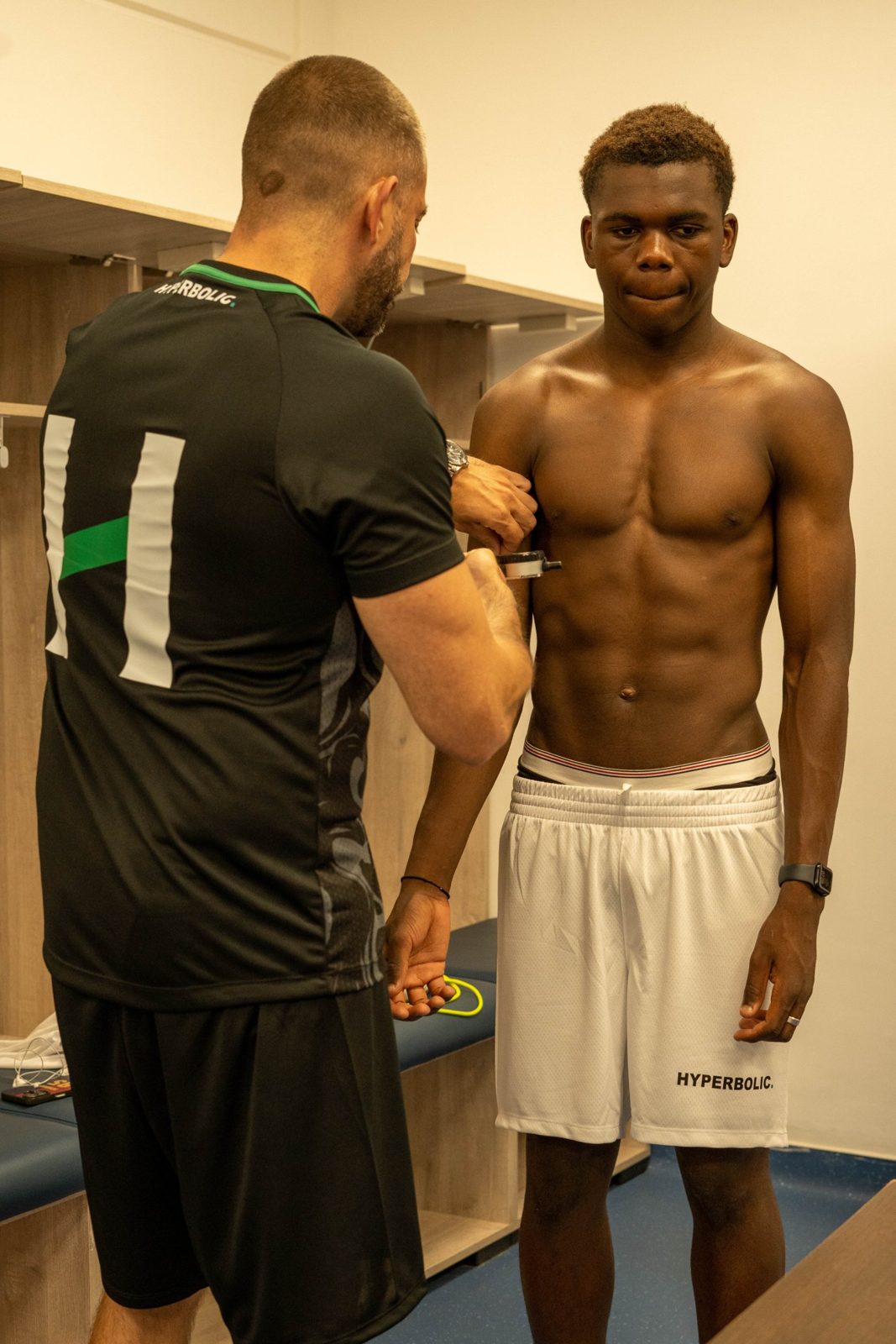
Skinfold callipers. They measure the thickness of a fold of skin and the fat just beneath it, at specific sites on the body. Those values go into an equation that estimates body fat percentage. It is quick, completely safe, and can be repeated every month. Its limit is the hand of the person measuring: two people will not get exactly the same result on the same player.
DEXA. This is a scan that comes from medical imaging and serves as the reference. In a few minutes, lying down, the player gets his fat mass, lean mass and bone mass, region by region. The radiation dose is very low. Some academies offer it to their players; otherwise you need to go to a specialist centre. It is still sensitive to hydration and to the last meal, and its price rules it out as a monthly tracking tool.
Smart scales. They display a body fat percentage by sending a weak electrical current through the feet. In reality, they mainly estimate body water. After a big glass of water, straight after training, or in the evening rather than the morning, the result changes without the body having changed at all. For tracking a growing teenager, I do not rely on them.
One point few parents know: each method has its own scale. 11% measured by DEXA and 11% measured with callipers do not describe the same body. Comparing your son's number with that of a teammate measured another way makes no sense at all.
3. How I measure, and why never before 15
I use callipers with the Durnin and Womersley protocol, at four sites: biceps, triceps, below the shoulder blade and just above the hip. We always measure on the same side and under the same conditions. From one check-up to the next, the same person also holds the callipers, so the hand does not distort the comparison. The measurement takes place once a month, at the monthly review. It is one of the markers of the BodyFitWithMe method.
The Durnin and Womersley equations were developed on people aged 16 and over. Before that age, they were not designed for the job, and the body changes too quickly for a percentage to mean anything from one month to the next. Under 15, I track growth: weight and height, read together on an age-based chart. That is enough to adjust nutrition, and it avoids putting a number on a 13-year-old's body.
With female players, I never measure body fat. Tracking is done with body measurements, including waist circumference at the level of the navel, once a month.
4. Read the trend, not a single number
A percentage on its own tells me very little. What matters is how weight and skinfolds move together from one check-up to the next, because that is what tells me what to adjust in the plan.
| Weight | Skinfolds | What it means |
|---|---|---|
| Rising | Stable | He is building lean mass. The plan is working, we carry on. |
| Stable | Falling | He is losing a little fat and gaining muscle. In mid-season, this is often the best scenario. |
| Rising | Rising | The surplus is too large. We trim it slightly, keeping the fuel around sessions. |
| Falling | Falling fast | He is not eating enough for what he burns. We raise his intake before performance drops off. |
Height is part of the picture too. During the growth spurt, a player can gain several centimetres in a few months, and weight logically follows. Weight gain that comes with a growth spurt is nothing to worry about; it is exactly what we expect. Why a teenager's needs are so specific: a young footballer does not eat like an adult.
If your son has a DEXA scan at his club, keep the report. I use it to recalibrate the target, bearing in mind that the two methods cannot be compared number for number.
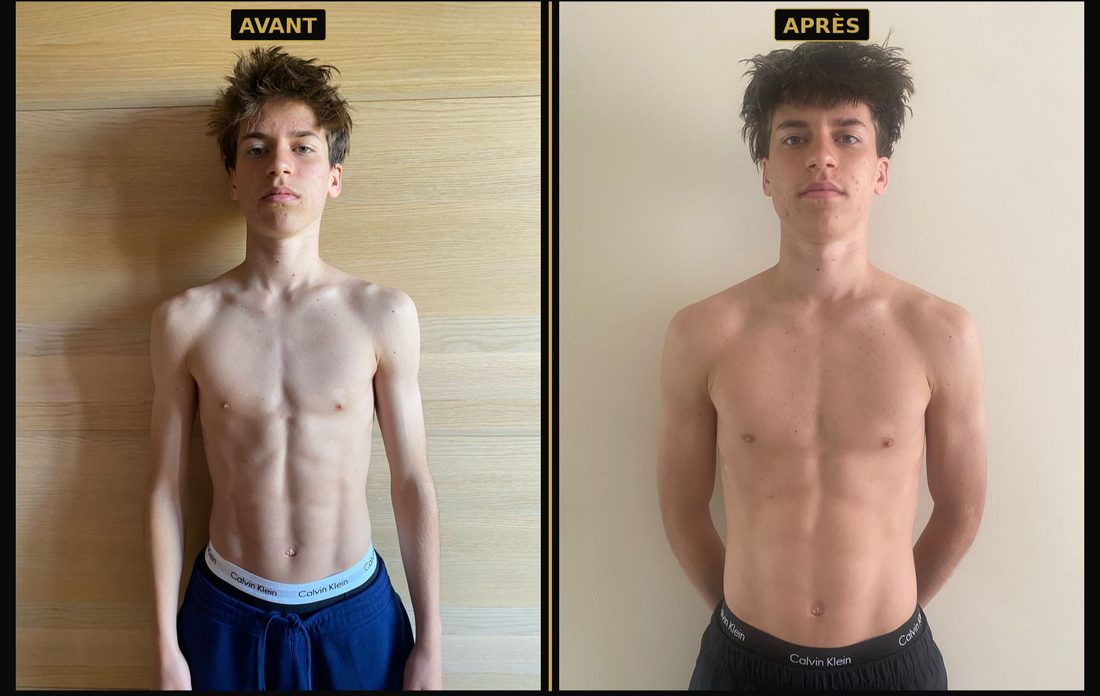
Lukas, KAA Gent U18: around ten kilos in a year
Lukas gained around ten kilos over a year of coaching. Looking at the scales alone, weight gain like that could worry a parent.
That is where measurement changes everything: tracked every month under the same conditions, it confirms that the kilos gained are lean mass, not fat. That is precisely what the first row of the table shows: weight rising, skinfolds stable.
The full method is explained in the article on how to build muscle as a young footballer.
Chasing the lowest percentage
On social media, your son sees very lean pros with sculpted abs. He can quickly convince himself that the leaner he gets, the better he will be. Beyond a certain threshold, the opposite is true: less in the tank at the end of matches, slower recovery, a rising risk of injury and growth that can slow down.
The International Olympic Committee has devoted several consensus statements to what it calls relative energy deficiency in sport, often shortened to RED-S. When what the player eats no longer covers what training and growth demand of him, the body starts saving everywhere: on bones, hormones, immune defences and performance. Boys are affected too; it is not an issue reserved for female athletes.
With a young player, I aim for a range in which he stays sharp while continuing to grow. The measurement is there to adjust what he eats, never to judge his body.
One piece of advice: that number stays between your son, you and his coach. It is not discussed at the dinner table and it is not compared with a teammate's. At this age, a healthy relationship with food is also shaped by what he hears at home.
5. What you can track at home
No special equipment needed. These markers are enough, as long as they are taken properly.
- Weight, once a week. In the morning, before eating, after going to the toilet, on the same scales. Weighing every day causes needless worry: a difference of one to two kilos from one morning to the next is normal.
- Height, every three months. Against a wall, without shoes, ideally in the morning, since we lose a little height over the course of the day. In a growing player, it is the number that explains all the others.
- Waist circumference, once a month. At the level of the navel, with the same tape measure, without pulling it tight. If it stays stable while weight goes up, that is generally a good sign.
The body fat percentage shown by your smart scales, you can ignore. Keep them for weight; that is what they do best.
And if his weight does not move even though your son feels he is eating a lot, the first question is how much he is really taking in. I explain the calculation in how many calories a young footballer needs.
Key takeaways
Weight remains a useful marker, provided you know what it cannot see. Two extra kilos can be the best news of the month or a signal that something needs correcting.
What settles it is a measurement taken every month under the same conditions and read alongside height. Before 15, we track growth and leave percentages aside.
And the real judge is still the pitch: a player who keeps hitting his sprints until the last minute and recovers well from one match to the next.
Your questions, my answers.
Around 15 or 16, with skinfold callipers. The Durnin and Womersley equations were developed on people aged 16 and over, and before that age the body changes too quickly for a percentage to mean anything. Under 15, we track weight and height on a growth chart.
Not for tracking a teenager. They work by impedance and mainly estimate body water: the result changes after drinking, after training or depending on the time of day. They are still useful for weight.
DEXA is a reference scan that separates fat mass, lean mass and bone mass region by region, but its cost means it cannot be repeated every month. Callipers are quick, safe and repeatable, provided the same person measures under the same conditions. The two methods do not use the same scale and cannot be compared number for number.
No. Beyond a certain threshold, going lower costs energy at the end of matches, slows recovery, increases the risk of injury and can hold back growth. The goal is a range in which the player stays sharp on the pitch while continuing to grow.
Keep reading.
Building muscle without fat
The method for gaining lean mass as a young footballer aged 15 to 21.
How many calories does a young footballer need?
The real calculation of needs, from 13 to 21, and how to check it.

Why a young footballer does not eat like an adult
Growing, learning, performing, recovering: a teenager eats for four.
Beyond the scales, where does he really stand?
A free two-minute audit to take stock of your son's nutrition and find out what needs adjusting.