
Your son is 16, weighs 60 kg, trains five times a week and plays at the weekend. You type "how many calories for a teenage athlete" into Google. You find a figure: 2400 kcal.
That figure is wrong. Not approximate. Wrong, in the sense that it matches nothing in his daily life.
The problem is not the calculation. The problem is that almost every online tool is built for a sedentary adult, or an adult who goes to the gym three times a week. An academy player is neither. He combines four areas of expenditure at the same time: his basal metabolism, his training load, his school day and his growth.
Here is how we build the real figure, item by item. And above all, how to check within two weeks that it is correct, because a calculation without verification is worthless.
1. Basal metabolism: what his body burns doing nothing
This is the starting point of any serious calculation. Basal metabolism, or BMR, is the energy the body uses at complete rest to run the heart, brain, lungs and body temperature. Nothing else.
The reference formula is Mifflin-St Jeor, recognised as the most reliable way to estimate this figure. For a boy, it gives:
BMR = (10 × weight in kg) + (6.25 × height in cm) − (5 × age) + 5
For our player aged 16, 60 kg, 1.75 m, this gives around 1620 kcal a day. That is what he would burn lying in bed all day without moving.
Keep this figure in mind. Some parents think 2000 kcal is already "eating a lot" for a teenager. In reality, at 2000 kcal, this player barely covers his basal metabolism and his school day. He has not yet put anything in the tank for training.
2. What a football session really costs
This is where generic calculators fall apart completely. They offer an "activity level" to choose between sedentary, moderate and intense. An academy player ticks "intense", the tool multiplies by 1.7 and displays a figure. Except that football is not a continuous activity.
A footballer covers 10 to 12 km per match, but most of the energy cost does not come from the distance. It comes from accelerations, changes of direction, braking and repeated sprints. It is high-intensity intermittent exercise, far more costly than a jog of the same length.
In practice, for a 60 kg player:
| Session | Estimated expenditure |
|---|---|
| 90-minute technical session | around 500 to 650 kcal |
| Intense or opposed session | around 650 to 850 kcal |
| Full match | around 800 to 1000 kcal |
| Strength session | around 250 to 400 kcal |
A player who strings together five sessions and a match in the week therefore adds 3500 to 4500 kcal to his weekly expenditure, from football alone. This is the item that mainstream tools systematically underestimate.
3. The item nobody counts: growth
A 28-year-old adult who trains five times a week eats for two things: living and recovering. A 15-year-old player eats for four: living, recovering, getting through a school day and growing. That is the whole subject of why a young footballer does not eat like an adult.
This fourth item is invisible on the scales and absent from every calculator. Yet it changes everything. During the growth spurt, usually between 13 and 16 in boys, the body is continuously building bone, muscle and nerve tissue. This construction site runs 24 hours a day, including rest days.
The energy strictly needed to build these new tissues is modest in absolute terms. What is costly is the consequence of a shortfall. When intake is insufficient, the body prioritises. And the order is always the same: maintain vital functions first, fuel exercise next, build last.
A player in chronic deficit does not complain about hunger. He recovers poorly, gets injured more often, stays flat on the scales while his teammates gain 4 kg, and finishes his matches running on empty. It is not a lack of character. It is a lack of fuel, and I see it every week at the training ground.
4. Real ranges, by age group
Here are the orders of magnitude I observe in the players I coach in academies. They are reference points, not prescriptions: two players of the same age can be 600 kcal apart depending on their build, position and actual load.
| Age group | Daily reference |
|---|---|
| U13 (12-13 years) | around 2200 to 2600 kcal |
| U15 (14-15 years) | around 2500 to 2900 kcal |
| U17 (16-17 years) | around 2700 to 3200 kcal |
| U19 to U23 (18-21 years) | around 3000 to 3500 kcal |
These figures rise further when the goal is building muscle, where a calibrated surplus of 200 to 300 kcal is added. They tighten during injury, but they never collapse: a sidelined player who cuts his intake drastically loses muscle, not fat.
Above all, these figures are not the same every day. That is the next point, and it is the most important.
Believing one figure works for the whole week
This is the number one mistake after a calculation. The parent gets 3000 kcal, and the player eats 3000 kcal every day, including Sunday when he does nothing.
A Tuesday with a double session and a Sunday of complete rest do not require the same thing. The real gap is between 300 and 400 kcal, almost entirely in carbohydrates. Protein and fats stay stable all week, because muscle repair does not stop on rest days.
This is what we call nutritional periodisation. A single figure applied seven days a week has two effects: fat gained on quiet days and a lack of energy on heavy days. The same player can therefore be in surplus and in deficit in the same week.
Get his starting figure in 2 minutes
I built a calculator that applies exactly the logic of this article: basal metabolism using Mifflin-St Jeor, then adjustment for training volume, number of matches, level of play and goal. It gives the calories, the split between protein, carbohydrates and fats, and the hydration target.
Free, no sign-up, instant result.
5. The total is not enough: the split decides the result
Two players at 3000 kcal can get opposite results. The one who reaches his total with white bread, sugary cereals and bars will build nothing. The one who reaches it with the right split makes progress.
The guidelines I apply with my players:
- Protein: 1.6 to 2.0 g per kilo of body weight. For a 60 kg player, that is 96 to 120 g a day, spread across all meals and snacks rather than concentrated in the evening.
- Carbohydrates: 5 to 7 g per kilo depending on the day's load. For 60 kg, that ranges from 300 g on a quiet day to 420 g on a double-session day. This is the lever we adjust.
- Fats: 1 to 1.2 g per kilo. For 60 kg, 60 to 72 g a day. Olive oil, nuts, whole eggs, oily fish. We never go below this in a teenager, as fats support hormone production.
There is one more item that is almost always forgotten: hydration. The baseline is around 40 ml per kilo of body weight, or 2.4 litres for a 60 kg player, plus 0.5 to 1 litre on training days. Even mild dehydration lowers performance before thirst is even felt. The details are in hydration for footballers.
6. How to know within two weeks whether the figure is right
This is the step everyone skips, and yet it is the only one that counts. Any calculation remains an estimate. The body gives the exact answer. You just need to know how to read it.
The protocol: apply the figure for fourteen days without changing it, and weigh the player twice a week under identical conditions. In the morning, on an empty stomach, after using the toilet, before training. It is the consistency of the conditions that makes the measurement useful, not the frequency.
Reading the result: when the goal is muscle gain, healthy progress is between 0.3 and 0.7 kg per month. Any faster and a significant share of the gain is fat. If weight is completely flat over fourteen days, intake is too low and 150 to 200 kcal should be added.
The signals that matter more than the scales: the quality of the last twenty minutes of a session, freshness on waking, the ability to handle two heavy days in a row and the frequency of minor muscle injuries. A properly fuelled player finishes his sessions. A player in deficit fades at the end.
An important point for under-15s: in a player who is still growing, height changes at the same time as weight. Weight that seems to stall can hide several centimetres gained. That is why I always track both together, with a growth chart, rather than weight alone. Why the scales alone are not enough: body fat in young footballers.
Key takeaways
The right figure for a young footballer does not come out of a generic calculator. It is built item by item: basal metabolism, the real cost of sessions, the school day, growth. Then it is adjusted to the day's load.
In the vast majority of cases I see, the player is not eating too much. He is eating too little, at the wrong time, and he pays for it at the end of matches and in his physical progress.
A calculation gives you a starting point. Two weeks of observation give you the truth. It is this loop, repeated week after week, that helps a player progress.
Keep reading.

Why a young footballer does not eat like an adult
Growing, learning, performing, recovering: a teenager eats for four.
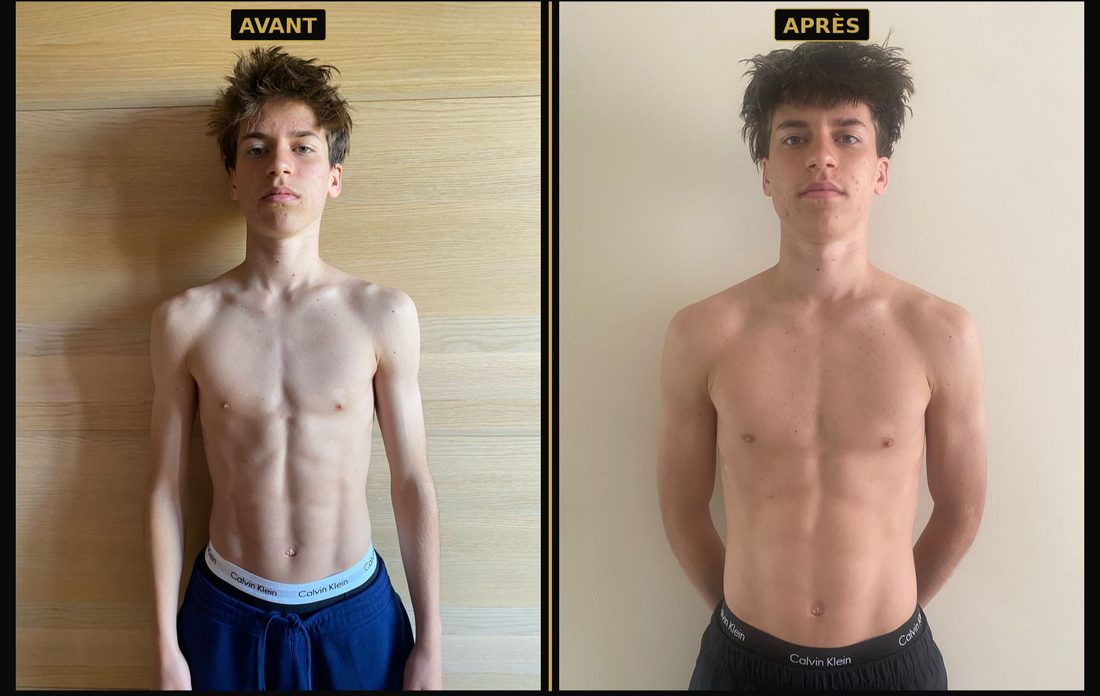
Building muscle without fat
The method for gaining lean mass in a young footballer aged 15 to 21.

Body fat: why the scales are not enough
Callipers, DEXA, smart scales: what each method is worth.
Is your son's nutrition matching his ambitions?
A free 2-minute quiz to find out exactly where he stands and what needs adjusting.