
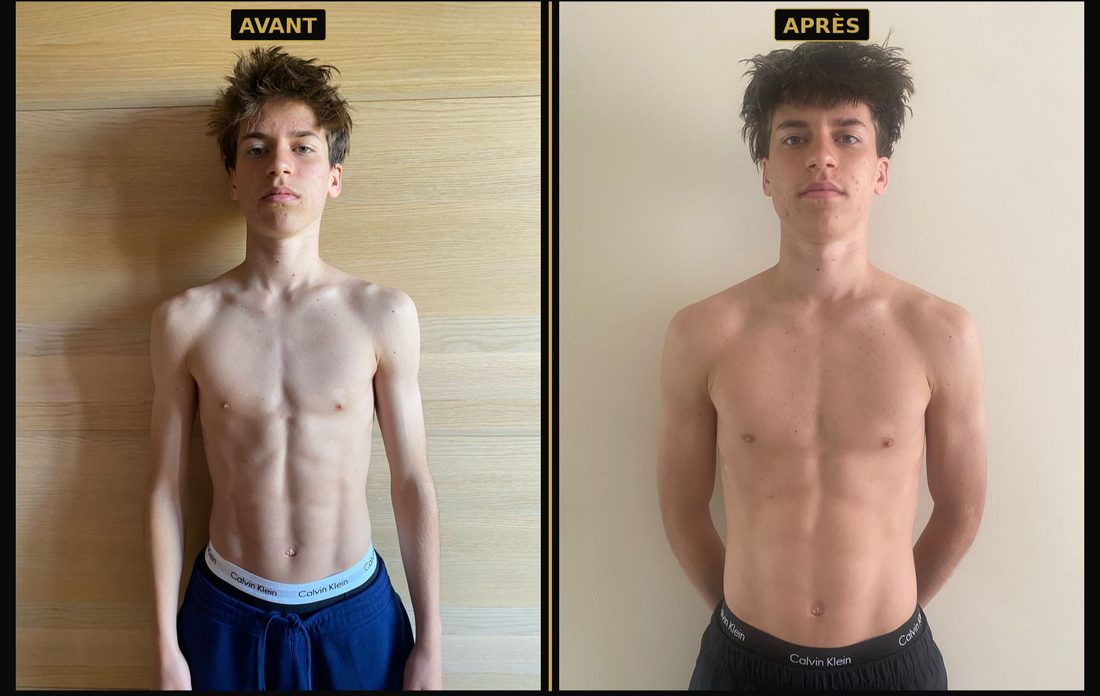
Your son comes home from the match. He is 16 and weighs 58 kg. He complains about being pushed off the ball in duels. He watches others put on 5 kg while he stands still.
He starts hearing about "bulking". Online, he finds protocols written for adult bodybuilders: 4000 kcal, 5 shakes a day, creatine, mass gainer. The promise: +10 kg in 3 months.
That is exactly what not to do at 16.
Lean muscle gain in a young footballer means +5 to 10 kg over 6 to 12 months. Useful muscle, not useless fat. Here is exactly how we go about it: the method I use with my academy players.
1. The golden rule: structure before intensity
Most young players who want to build muscle start by "eating more". More pasta in the evening, more bread, more of everything. The result after 3 months: 4 kg of fat around the waist, heavier legs in matches, less speed.
Real lean muscle gain does not start with quantity. It starts with structure: how many times a day you eat, at what time, with what ratio.
A U15 to U21 player who moves from 3 meals to 5 structured eating occasions (3 meals and 2 snacks) already gains 2 to 3 kg in 6 weeks, without increasing anything else. Simply by spreading out better what he already eats.
2. A calibrated calorie surplus: 200 to 300 kcal, no more
To build muscle, the body needs a slight energy surplus. But "slight" is the key word. Too large a surplus means stored fat. Too small a surplus means stagnation.
The range that works for young footballers: +200 to +300 kcal above actual expenditure. That is very little. It is exactly what is needed.
For a 60 kg academy player who trains 5 to 7 times a week, that means around 2800 to 3000 kcal a day, periodised according to the day's load (more on training days, less on rest days). The full expenditure calculation is explained in how many calories a young footballer needs.
3. The macros that build muscle
Out of a total of 2800 to 3000 kcal, here is the split that works:
- Protein: 1.8 to 2.2 g per kilo of body weight. For a 60 kg player, that is 110 to 130 g a day. Enough to build, not so much that it overloads kidneys that are still growing.
- Carbohydrates: 5 to 7 g per kilo. This is the foundation. For a 60 kg player: 300 to 420 g a day. Carbohydrates are the fuel and the trigger for muscle gain via insulin.
- Fats: 1 to 1.2 g per kilo. For a 60 kg player: 60 to 75 g a day. Good-quality fats (olive oil, nuts, whole eggs, oily fish) for hormones and vitamin absorption.
These are the figures I use with my players, from U15 to professional level. Adjusted to weight, position and training load.

Miracle powders and mass gainers
Online, your son will come across adverts for mass gainers at 1000 kcal a shake. The promise: gain 10 kg in 2 months. The reality: 7 kg of fat, 3 kg of muscle and an upset digestive system.
At 15 to 21, the body has no need for heavy supplementation. A good-quality whey isolate after a session can be useful, but it never replaces a real meal or snack. Everything else (creatine, gainers, BCAAs, pre-workout) is unnecessary at this age. The full picture is in what a young footballer can really take.
Real muscle gain at this age comes from rice, chicken, eggs, oats and bananas. Not from powders. And that is what builds a body that lasts.
4. The number one lever: sleep
This is the most underestimated factor in young footballers. Muscle is not built during training. It is not built during meals. It is built during sleep.
It is during deep sleep that growth hormone is released at its peak. This hormone is literally what makes muscles grow and the body develop. Without it, you can eat 5000 kcal a day and nothing will build properly.
The target for a young footballer building muscle: 8 to 9 hours of sleep a night, with lights out before 11 pm on training days.
If your son sleeps 6 hours a night scrolling on his phone until 1 am, no nutrition plan will work. This is the first barrier to remove, before anything else.
5. The pre and post-training window
This is where 30% of muscle gain is won. Before and after every session, two critical windows:
- 1.5 hours before training: oats, banana and almonds. Complex carbohydrates, fast carbohydrates and a little fat. The body has its fuel.
- Within 30 minutes after training: a fast protein source (whey or Greek yoghurt), 1 banana and 2 dates. Glycogen is restored and muscle repair starts immediately.
This post-exercise window is so decisive that it deserves its own article: I cover everything in the 30 minutes after the match. Skipping just one of these two windows wastes the session as far as muscle gain is concerned. And when training comes straight after school, here is what to eat between school and evening training.
Lukas, KAA Gent U18: around ten kilos in a year
When Lukas started coaching, he was being pushed off the ball in duels, tired at the end of matches and frustrated to see his teammates more physically developed.
We put a simple protocol in place, with no miracle powder: 5 structured eating occasions, a calibrated surplus, a systematic pre and post-training window and more sleep.
After a year of regular follow-up, Lukas gained around ten kilos of lean mass, without ever losing speed or explosiveness. To check that the kilos gained are muscle and not fat, we do not just look at the scales: see body fat, and why the scales are not enough.
He now holds his own in duels against anyone in his age group. And he goes from match to recovery to training without fading at the end of the season.
Key takeaways
Successful muscle gain in a young footballer is not a sprint. It is groundwork over 6 to 12 months, structured, measured and adjusted.
The ingredients are simple: structured eating, a calibrated surplus, balanced macros, serious sleep and the pre and post-training window. No powders, no shortcuts, no absurd promises.
The result shows on the scales. But above all, it shows on the pitch: in duels won, in sprints sustained until the 90th minute, in confidence regained.
Keep reading.
What to eat before a football match?
Meal timing, foods to favour and foods to avoid on match day.

The 30 minutes after the match
The window most young players waste, and how to make the most of it.

What your fitness coach is not telling you
Why nutrition makes the real difference in a football academy.
Is your son's nutrition matching his ambitions?
A free 2-minute quiz to find out exactly where he stands and what needs adjusting.