
Best snack before football training: what to eat between school and the evening session
Your son trains five times a week for a single match. And between lunch and the evening whistle, he often goes six hours without eating anything. Here is what is at stake in that window, and the four fixes that change the end of the session.

He eats in the school canteen around midday. He finishes lessons at 3.30 pm. He waits, takes the bus and gets to the club around 5.30 pm. The session starts at 6 or 7 pm.
In between, he has eaten nothing. Sometimes a packet of biscuits bought on the way out of school. Sometimes nothing at all. And nobody worries, because "he'll eat when he gets home".
Most parents keep an eye on the pre-match meal. That makes sense: the match is the visible moment, the one you watch from the touchline. But an academy player plays once a week and trains four or five times. Training sessions are what build the level. The match only reveals it.
And almost all those sessions take place in the evening, at the end of six to seven hours without fuel. It is the most costly gap of the whole week, and also the simplest to fill.
1. Six hours without fuel before the hardest effort of the day
When nothing is eaten between midday and the session, the player arrives with glycogen stores already depleted by a whole day of lessons, concentration and growth. The body does not refuse to work. It works less well.
The UEFA nutrition consensus is clear on this point: carbohydrate availability directly determines the ability to repeat intense efforts, and a player who starts a session with low stores finishes it below his real level.
What this looks like on the pitch, and what coaches describe without always identifying the cause: a player who is fine for the first twenty minutes, then a drop in tempo, slower technical decisions and a second half of the session endured rather than played. Over a whole season, these repeated flat finishes cost far more than one bad match.
Add to that the injury factor. Fatigue at the end of a session degrades movement quality and joint stability. An empty player is not only less effective, he is also more exposed.
2. Lunch: does he really eat it?
This is the first thing to check, before anything else. Many players eat three forkfuls in the canteen, push the tray away and make up for it with biscuits in the afternoon. On paper, the meal happened. In the body, it did not.
What it should contain:
- A sufficient carbohydrate base: rice, pasta, potatoes, bread. This is the fuel for the 6 pm session, loaded six hours earlier.
- A source of protein: meat, fish, eggs, pulses.
- Vegetables, in a reasonable amount so as not to overload the stomach with fibre.
With my players, a typical lunch on a training day is around 90 g of rice weighed raw and 200 g of chicken, adjusted to weight and the day's load. The amount of carbohydrate at lunch is the first lever for the evening session, well ahead of any supplement.
If the canteen is not suitable, the solution is a meal prepared the night before and taken in a lunchbox. It is not a luxury: it is what players who handle the load over a whole season do.
3. The pre-training snack: the piece that is almost always missing
This is the number one point of intervention. The pre-training snack changes the end of the session immediately, from the very first week. It works in two stages, and it is exactly the protocol I apply with my academy players.
2 hours before the session, around 4 pm. Easily digested carbohydrates and a little protein, with little fat and little fibre. In practice: 60 g of rice weighed raw with 100 g of chicken. If that is not possible between school and the club, a sandwich with 60 g of ham or chicken does the job, provided the bread is low in fibre.
This is the only time of day when white bread or a baguette is better than wholemeal: fibre slows gastric emptying and sits heavy on the stomach during the warm-up. Wholemeal bread keeps its full place at breakfast and at the evening meal.
45 minutes before, on the bus or in the dressing room. A source of fast sugar and a source of protein. I most often use two or three dates with a protein drink, but dates are an example, not a requirement: a very ripe banana, a fruit pouch or two slices of gingerbread do the same job. What matters is the pairing of fast sugar and protein, and that it travels well and does not sit heavy on the stomach during the warm-up.
Two snacks, five minutes of preparation, no special equipment. It is the most worthwhile fix of the whole week.
The amounts given here are guidelines for an academy player of average build. They are then adjusted to weight, position, the week's load and the goal, whether muscle gain or stabilisation. A 55 kg player and a 78 kg player do not eat the same thing at 4 pm.
Chocolate bars, fizzy drinks and energy drinks
This is what is available outside school and in vending machines. A chocolate bar on its own, fizzy drinks, crisps, sweets. The sugar spike rises fast and drops at exactly the moment the intensity of the session increases.
Do not confuse this with the dressing-room dates: the difference is that they arrive 45 minutes before exercise, together with protein, within a planned framework. Well-timed fast sugar is a tool. The same sugar taken alone at 3 pm, three hours before the session, is a trap.
The player then feels a slump that he puts down to his form on the day, when it is entirely down to what he ate forty minutes earlier. It is not a lack of character. It is a blood sugar problem.
A word on energy drinks, which are turning up more and more in kit bags from U15 upwards. The position of the American Academy of Pediatrics is unequivocal: the caffeine and other stimulants in these drinks have no place in the diet of a child or teenager. They provide no useful fuel; they provide sugar and a stimulant at a time when the night's sleep is already being prepared. They directly sabotage the recovery the session was meant to trigger.
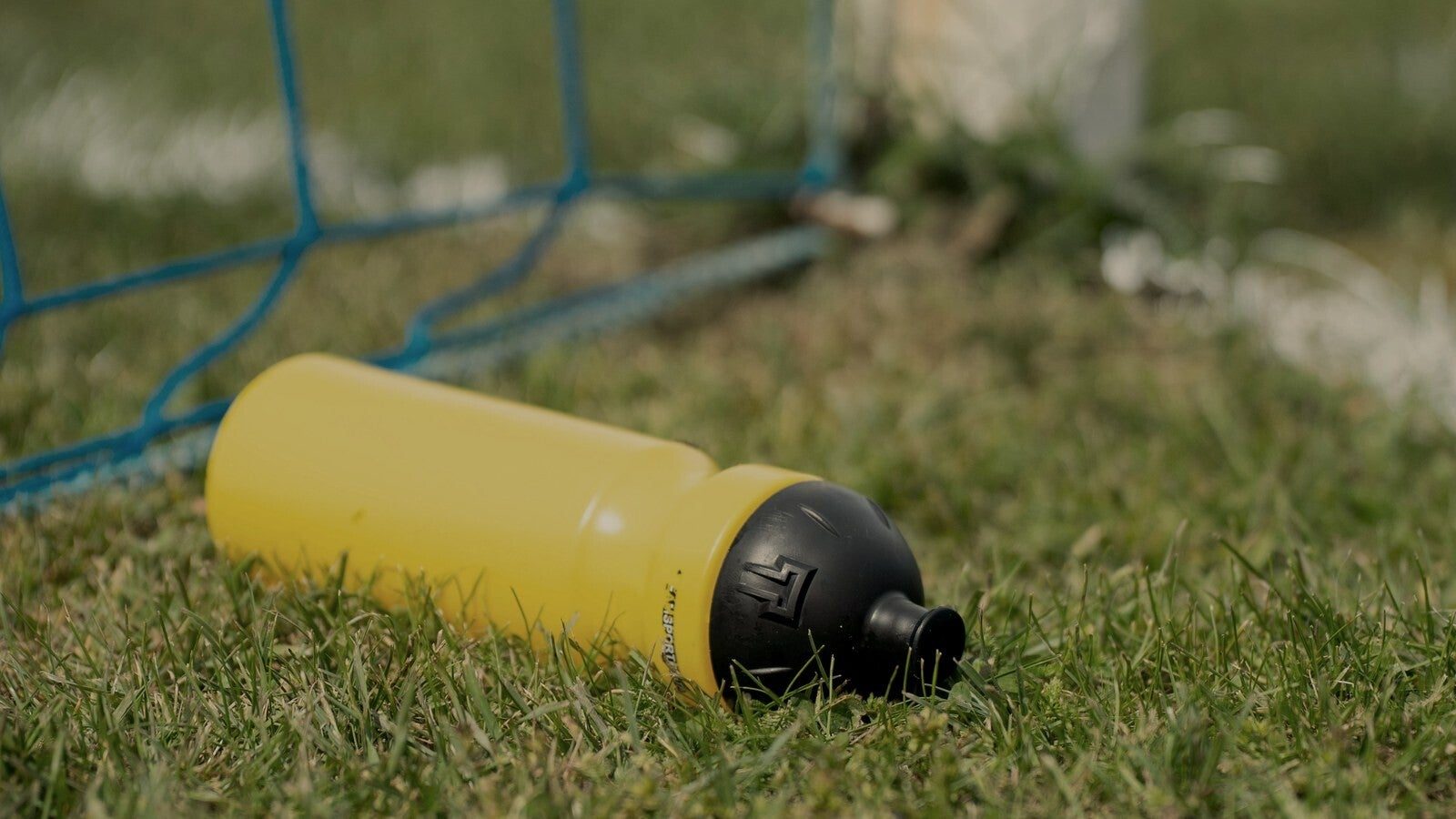
4. Hydration happens at school, not in the dressing room
A player who has his first drink on arriving at the club starts his session already in deficit. A loss of 2% of body weight in water is enough to reduce power, technical accuracy and concentration.
The target is simple to calculate:
Body weight (kg) × 40 ml = daily requirement
For a 65 kg player: 65 × 40 = 2,600 ml over the day, not counting what the session itself requires.
In practice, a water bottle in the school bag and the habit of filling it between every lesson are enough to cover most of this volume before he even reaches the pitch. It is one of the least demanding fixes of the whole week, and one of the most visible in the quality of the end of the session. The full details are in hydration for footballers.
5. Home at 9.30 pm: post-training refuelling cannot be skipped
Session over at 9 pm, shower, journey, home around 9.30 or 10 pm. The usual reflex is to eat very little, because it is late and he needs to sleep.
That is exactly the opposite of what is needed. The window after exercise is when muscle restocks its stores and starts its repair. A player who skips this meal four evenings a week reaches the weekend in debt, and that debt shows in the muscle gain that never comes.
Post-training refuelling happens in two stages.
Within 30 minutes, in the dressing room or in the car. A source of fast sugar and protein, nothing more. In practice: two or three dates and a protein drink, or a chocolate milk and a banana, or a drinking yoghurt with a fruit pouch. Again, several combinations work as long as both elements are there. The fast sugar restarts glycogen replenishment, the protein starts muscle repair. It is the most important step of the evening, and the one most often forgotten.
Combining carbohydrate and protein is not a matter of comfort: it speeds up glycogen replenishment when the recovery window is short, which is exactly the case when there is another session the next day.
At home, a proper but lighter meal. A source of protein, a carbohydrate base and little fat, so as not to weigh on digestion or sleep. With my players who get home late, this is often 70 g of rice weighed raw and 100 g of chicken. Soup and raw vegetables on their own do not do the job.
The principle is the same as after a match, in a lighter version. I explain the full mechanism in the 30 minutes after the match.
6. What stays in the bag all week
An organisation that lasts three months beats a perfect one that lasts ten days. The bag is packed once, on Sunday evening.
- A water bottle, filled before leaving in the morning
- A bag of dates or an equivalent portable fast sugar, for the 45 minutes before and the end of the session
- A protein drink or a chocolate milk, kept cool where possible
- A piece of fruit that travels easily, banana or apple
- A lunchbox prepared the night before, rice and chicken, for the 4 pm snack on days when timing allows
Five items, no special equipment, no significant extra budget. This is what turns a good intention into a habit that lasts until May.
When it is no longer a question of organisation
If, despite a snack in place and proper meals, your son remains constantly tired, loses his appetite over several weeks or sees his performance drop for no apparent reason, this is no longer about meal organisation.
Persistent fatigue in a teenage athlete warrants medical advice and a blood test, particularly of iron status. It is not something to treat with supplements bought without measuring anything first.
Key takeaways
The weekend is not prepared on Saturday morning. It is prepared over the four training evenings before it, and those evenings are decided in a window nobody looks at: the hours between lunch and the start of the session.
Four fixes, in this order:
- a lunch that is actually eaten;
- a two-stage pre-training snack;
- a water bottle filled at school;
- post-training refuelling, even at 10 pm.
None of them requires a diet, a budget or any particular constraint. They require a decision, then a week to build the habit. And the result does not show on the scales: it shows in the last twenty minutes of every session.
Scientific sources
- Collins J, Maughan RJ, Gleeson M, et al. UEFA expert group statement on nutrition in elite football. British Journal of Sports Medicine, 2021;55(8):416-442. View
- Bergeron MF, Mountjoy M, Armstrong N, et al. International Olympic Committee consensus statement on youth athletic development. British Journal of Sports Medicine, 2015;49(13):843-851. View
- Kerksick CM, Arent S, Schoenfeld BJ, et al. International Society of Sports Nutrition position stand: nutrient timing. Journal of the ISSN, 2017;14:33. View
- American Academy of Pediatrics, Committee on Nutrition and Council on Sports Medicine and Fitness. Sports Drinks and Energy Drinks for Children and Adolescents: Are They Appropriate? Pediatrics, 2011;127(6):1182-1189. View
The UEFA consensus on nutrition in elite football, turned into a practical protocol, is available free on the Football nutrition page.
Keep reading.
What to eat before a football match?
Meal timing, foods to favour and foods to avoid on match day.

The 30 minutes after the match
The window most young players waste, and how to make the most of it.
What to eat in the morning, before school and before a match
The right guidelines for the first meal of the day.
Is your son's nutrition matching his ambitions?
A free two-minute audit to find out exactly where he stands, and what needs adjusting around his evening sessions.