

Your son has moved into his academy's boarding house. He trains almost every day, he is growing, and the school kitchen decides what he eats. You no longer see his meals, and he does not really have a say in them.
I know this situation well. Several of the players I coach live in boarding, at different academies. The setup changes from one club to the next, but the principle stays the same: there is what cannot be changed, and what remains in his hands and yours. This article is about the second part.
1. What boarding changes for a player aged 14 to 18
Let us start with some good news: boarding brings regularity. Meals are served at set times, sleep is structured, and the days follow the same pattern. Many players who live with their parents do not have that stability.
The difficulty is that these meals are designed for pupils, not for teenagers juggling school, near-daily training and growth that is still under way. The kitchen does its job properly. It simply cannot know that a particular pupil has training at 5 pm and a match on Saturday.
There is also what you no longer see. At home, you notice when he skips breakfast or comes home starving. In boarding, that information gets lost, and the problem is often only discovered weeks later, on the scales or through fatigue.
2. The canteen: what he cannot change
In most of the boarding houses I know, each of the day's three meals provides around 600 kcal. Portions are fixed and menus do not change.
Do the maths. Three meals at 600 kcal comes to around 1,800 kcal a day. A young academy player who trains hard often needs far more: for a U15 with a heavy training load, you easily reach around 3,000 kcal. That leaves a shortfall of several hundred calories every day, sometimes a thousand. And that shortfall cannot be made up in the canteen. The detailed calculation is in how many calories a young footballer needs.
In the canteen, his job is mainly to leave nothing behind. Eat the whole portion of meat or fish, take the bread when there is some, go back for more starchy food if that is allowed. Drink water rather than sugary drinks. Nothing more, and that is already a lot for a teenager who does not like the dish of the day.
3. Snacks: where the week is won or lost
What is missing has to come from elsewhere, and during the week, that elsewhere is snacks. It is the only part of the day over which he really has control.
There are four moments to cover, depending on his timetable:
- Mid-morning, if breakfast is served early and the morning is long.
- Before training, ideally an hour and a half to two hours beforehand, so he does not arrive on the pitch running on empty.
- After training, within the hour, to recover. This is the moment that matters most.
- In the evening, when dinner is served early and the night is long.
A good snack combines carbohydrates and a source of protein. In boarding, it also has to fit in a bag, often without a fridge. What works well:
- wholemeal bread sandwiches with hard cheese or peanut butter, in a lunchbox;
- a banana, an apple or a fruit purée pouch;
- chocolate milk in a carton, which keeps without a fridge and works well after a session;
- a handful of plain nuts or almonds;
- rice cakes or simple cereal bars with a short ingredient list.
If the boarding house has a shared fridge, quark, skyr or drinking yoghurts widen the options considerably. Check the rules: some boarding houses do not allow food in the rooms, others provide a dedicated space for it.
Bernardo, KRC Genk U16, lives in his academy's boarding house. Since July 2025, he has gained 10.2 kg, with stable body fat. Even when you do not choose your meals, progress remains possible.
4. Weekends at home: restoring balance, not stocking up
On Friday evening, the temptation is strong. He comes home tired and hungry, and you want to treat him. A meal he loves, of course. But the weekend is not there to make up for the whole week in two days, and a stomach does not store reserves for the following Tuesday.
The weekend is rather the time to give him what the canteen provides poorly. Plenty of vegetables and fruit, fish, good-quality starchy foods, meals at regular times and full nights of sleep. If there is a match, the day is organised around it: a pre-match meal at the right time and proper recovery afterwards.
It is also the right time for a weigh-in, always under the same conditions: in the morning, before eating, after going to the toilet. Once a week is enough. It is the trend over several weeks that counts, not the number on one particular Sunday.
5. Sunday evening: what you can prepare
This is when you have the most influence over his week. A few simple steps:
Count the snacks. Look at his timetable for the week, the training days and match days, and prepare the number of snacks he will actually need. A training day calls for more than a rest day.
Vary them. The same bar five days in a row ends up at the bottom of the bag by Thursday. Rotate between two or three options.
Let him choose. Offer a list of approved options and let him put his own selection together. A teenager is far more willing to eat what he has chosen himself.
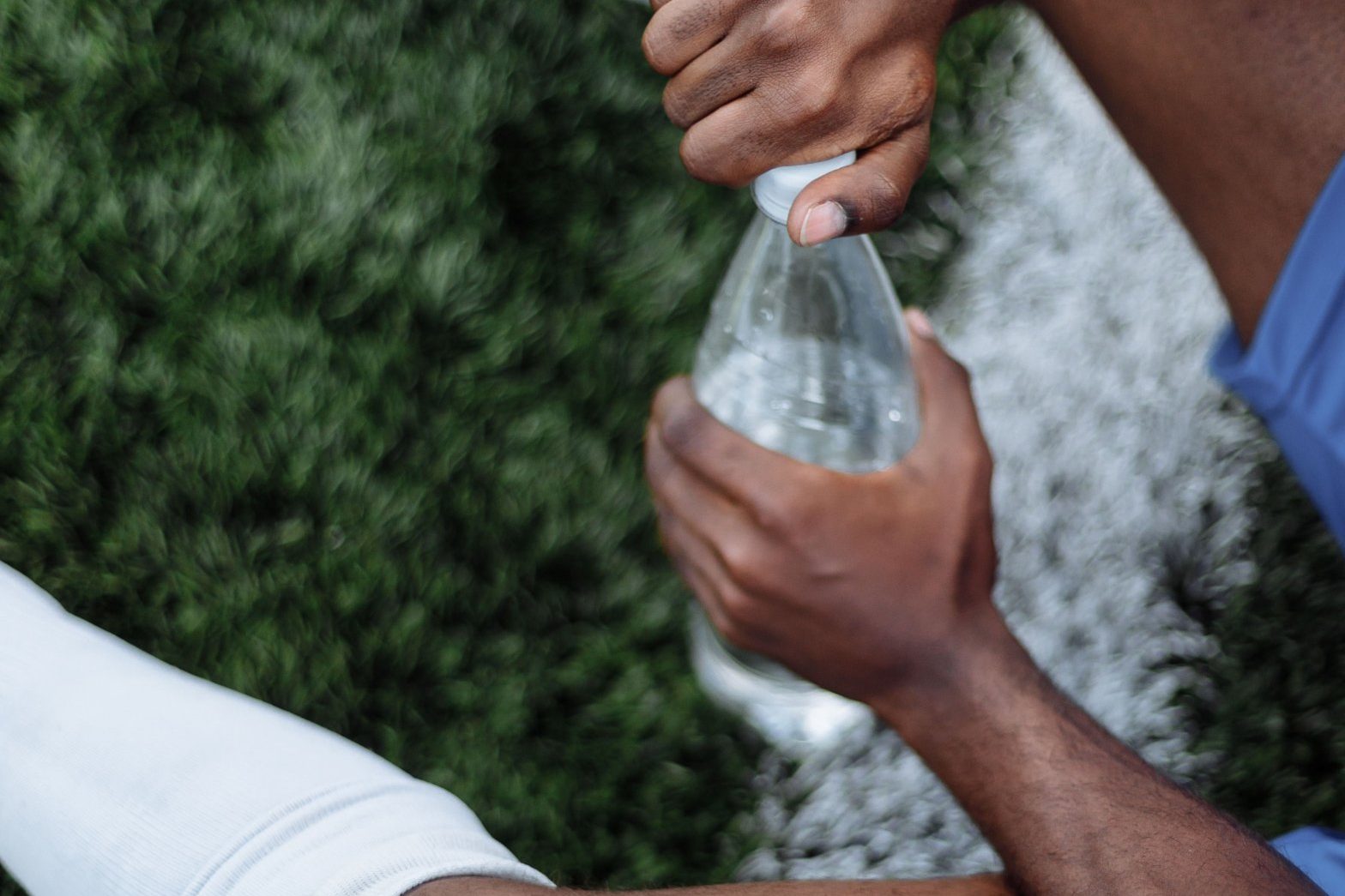
Remember the water bottle. Allow around 40 ml per kilo of body weight per day, a little more on training days. For a 60 kg player, that comes to around 2.4 litres. A bottle he likes and always keeps with him helps more than any reminder. More guidance in hydration for footballers.
The most important thing is to keep this routine going week after week. A well-packed bag every other Sunday does not achieve much.
6. Warning signs to watch for
Since you no longer see him eat, other clues will tell you how he is doing:
- his weight stalls or drops over several weeks, even though he is in the middle of a growth phase;
- he comes home on Friday exhausted and starving, every week;
- the staff report a drop in performance towards the end of the week;
- minor muscle injuries keep piling up;
- he sleeps badly or struggles to get up, despite regular hours.
None of these signs is enough to make a diagnosis on its own. But if several of them add up, it is time to take a closer look at what he really eats during the week. And if you have any doubts about his health, speak first to the club doctor or your GP.
Further reading
For the full picture (energy needs, pre-match, recovery, growth), the complete guide to nutrition for young academy footballers covers everything in detail.
Keep reading.
The 30 minutes after the match
The window most young players waste, and how to fill it.
What to eat before a football match?
Meal timing, foods to choose and foods to avoid on match day.

What your fitness coach does not tell you
Why nutrition makes the real difference in a football academy.
Where does your son really stand?
The nutrition quiz takes two minutes and gives you a first reading of his situation, even from a distance.